



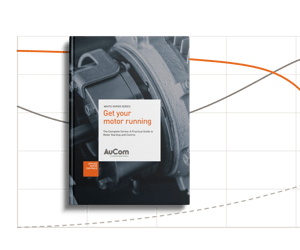
GET YOUR MOTOR RUNNING

The complete guide to motor starting and control
Five technical papers in one reference, covering what determines starting performance, how the principal starting and control methods differ, and how to select the right approach for the application as a whole.
Inside the handbook
Five technical papers take you from the fundamentals of motor starting through to the selection and application of soft starters and variable frequency drives.
 Reduced-voltage starting of three-phase induction motors
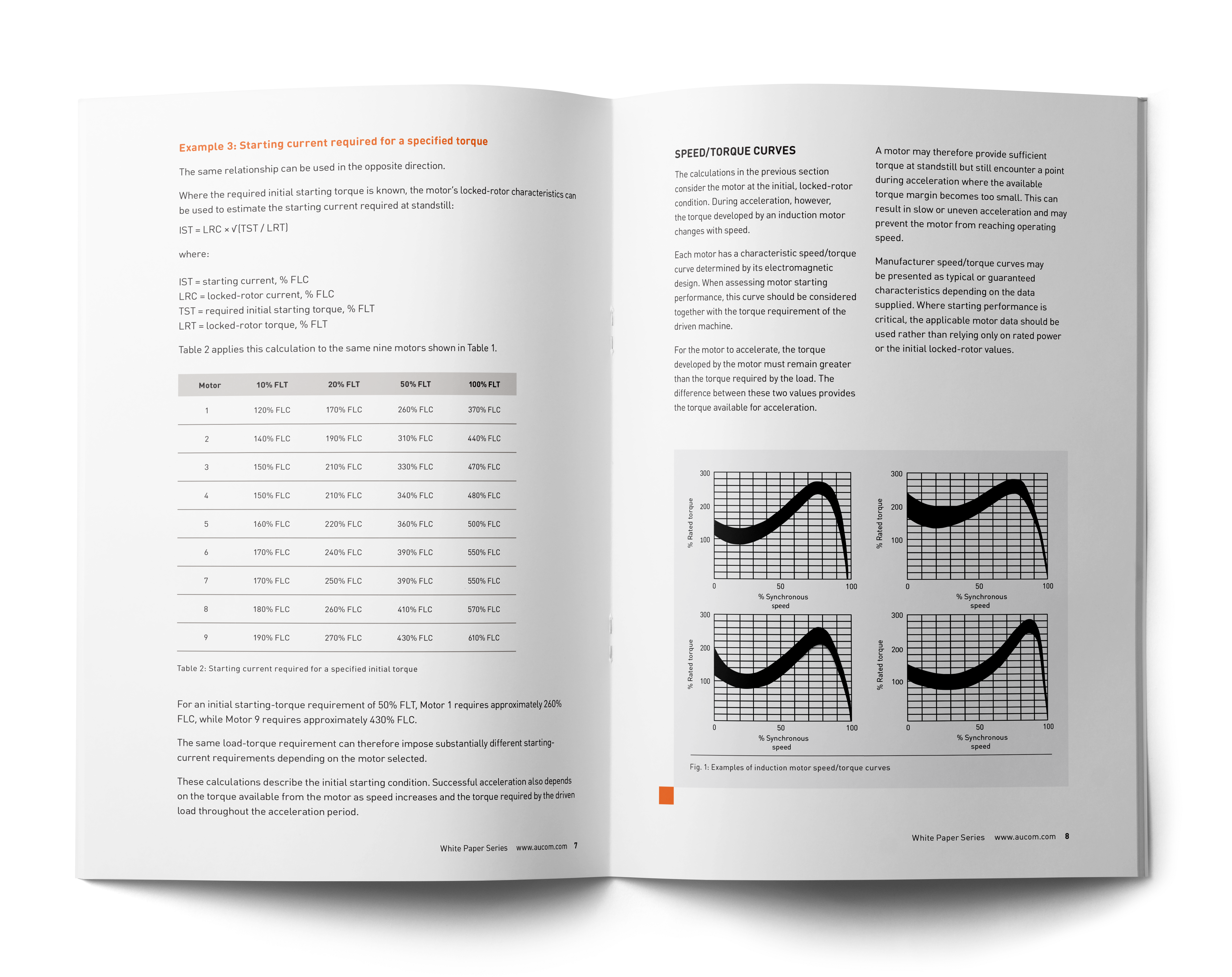
What happens when starting current is restricted, and why motor design decides the outcome. Nine four-pole 110 kW motors with similar rated power, speed and efficiency are compared at the same current limit: at 300% FLC the available initial torque ranges from 24% to 65% of full-load torque. Covers locked-rotor current, locked-rotor torque and the speed/torque curve.
Read Part 1 on its own
Reduced-voltage starting of three-phase induction motors
What happens when starting current is restricted, and why motor design decides the outcome. Nine four-pole 110 kW motors with similar rated power, speed and efficiency are compared at the same current limit: at 300% FLC the available initial torque ranges from 24% to 65% of full-load torque. Covers locked-rotor current, locked-rotor torque and the speed/torque curve.
Read Part 1 on its own
 Starting torque requirements of machines and motor loads
What the driven machine requires from the motor during starting. Breakaway torque, work torque, acceleration torque and inertia, with worked examples for a punch press, a centrifugal fan, a compressor and a flywheel, plus the equations for full-load torque, acceleration torque and reflected load inertia.
Read Part 2 on its own
Starting torque requirements of machines and motor loads
What the driven machine requires from the motor during starting. Breakaway torque, work torque, acceleration torque and inertia, with worked examples for a punch press, a centrifugal fan, a compressor and a flywheel, plus the equations for full-load torque, acceleration torque and reflected load inertia.
Read Part 2 on its own
 Motor starting solutions
The principal methods compared: direct-on-line, primary resistance, auto-transformer, star-delta, soft starter and variable frequency drive. Covers open-transition and closed-transition switching, why the transition point matters more than the initial current reduction, and a side-by-side comparison of all six methods.
Read Part 3 on its own
Motor starting solutions
The principal methods compared: direct-on-line, primary resistance, auto-transformer, star-delta, soft starter and variable frequency drive. Covers open-transition and closed-transition switching, why the transition point matters more than the initial current reduction, and a side-by-side comparison of all six methods.
Read Part 3 on its own
 Solid-state soft starters
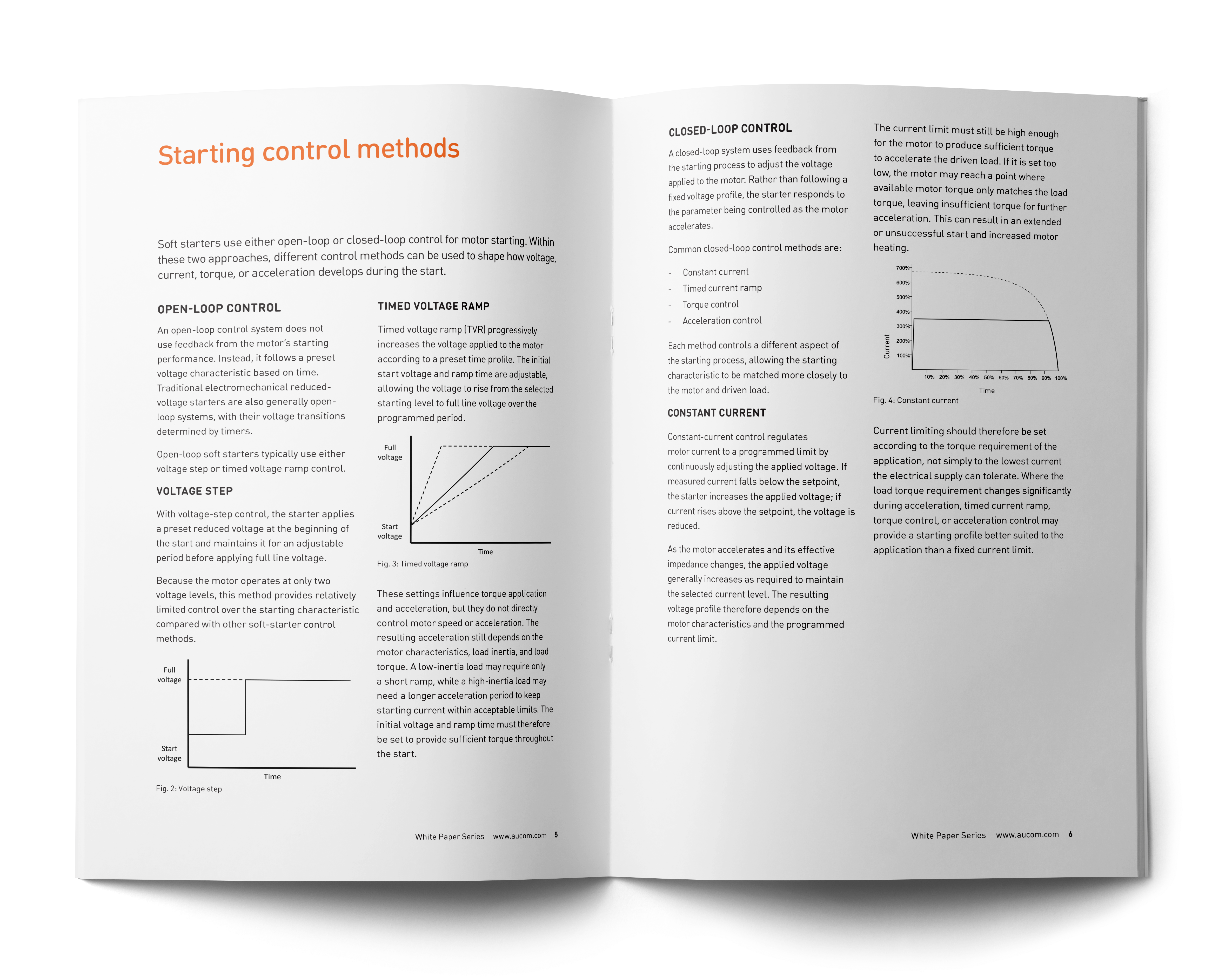
Controlled starting for fixed-speed applications. Open-loop and closed-loop control methods, from timed voltage ramp through to acceleration control. Also covers SCR thermal duty, AC-53 utilisation codes and ratings tables, motor protection, semiconductor fuse coordination, and power factor correction capacitor switching.
Read Part 4 on its own
Solid-state soft starters
Controlled starting for fixed-speed applications. Open-loop and closed-loop control methods, from timed voltage ramp through to acceleration control. Also covers SCR thermal duty, AC-53 utilisation codes and ratings tables, motor protection, semiconductor fuse coordination, and power factor correction capacitor switching.
Read Part 4 on its own
 Variable frequency drives
How a VFD controls speed and torque across the operating range. V/F, sensorless vector and closed-loop vector control, the constant-torque and constant-power regions, load characteristics and energy use, drive and motor selection, harmonics and mitigation, braking methods, and synchronous transfer.
Read Part 5 on its own
Variable frequency drives
How a VFD controls speed and torque across the operating range. V/F, sensorless vector and closed-loop vector control, the constant-torque and constant-power regions, load characteristics and energy use, drive and motor selection, harmonics and mitigation, braking methods, and synchronous transfer.
Read Part 5 on its own